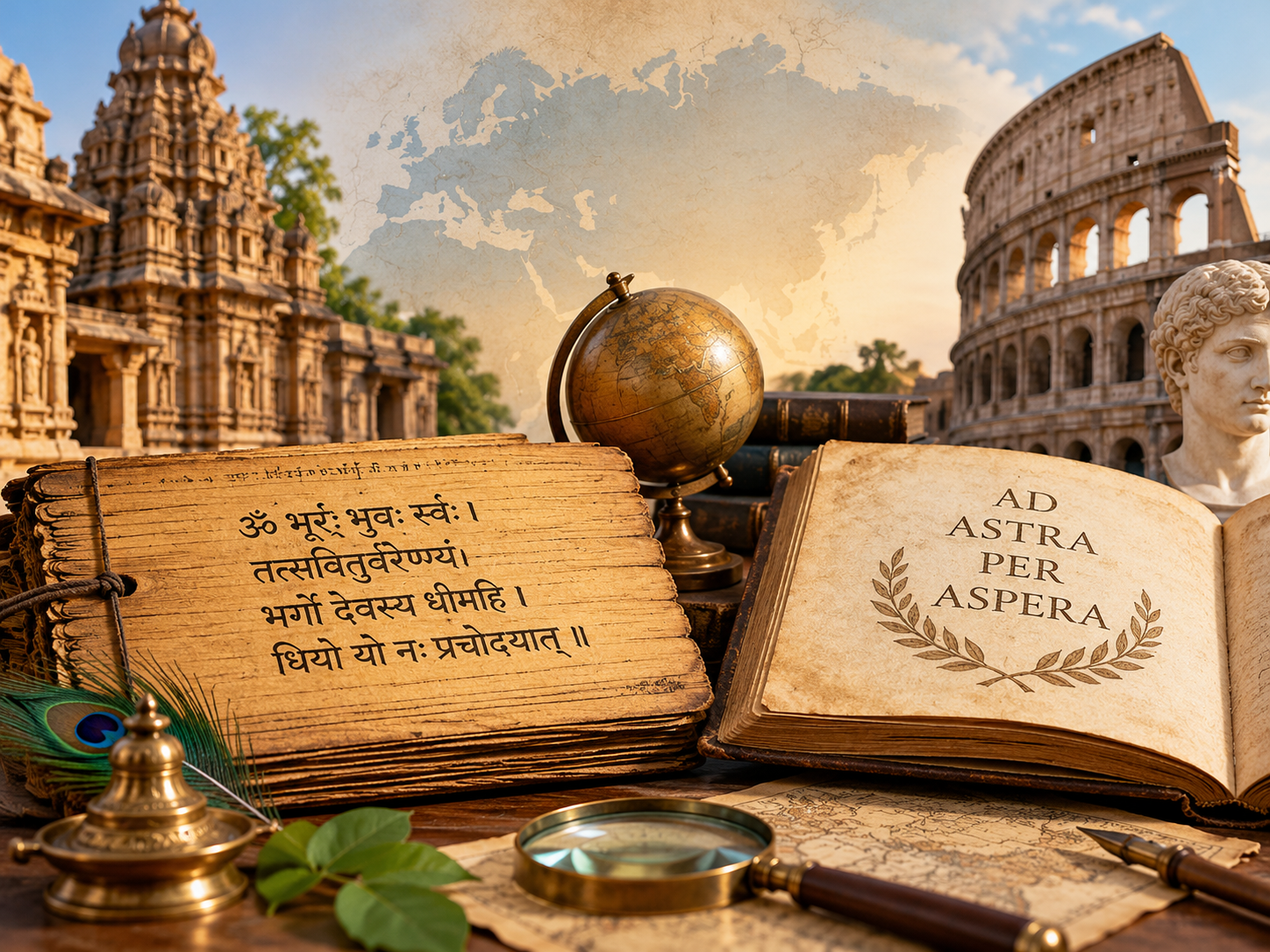
Sanskrit and Latin offer valuable insights into the history of languages, revealing connections that linguists trace to a common ancestral language. Both belong to the Indo-European language family, which includes several languages spoken across Europe and parts of Asia. Their similarities in vocabulary, grammatical structures and certain word forms help researchers investigate how languages evolved and spread over time. Sanskrit preserves an extensive tradition of ancient Indian literature, including the Vedas, while Latin played a major role in Roman literature, law and scholarship. Their historical importance extends beyond grammar, offering perspectives on the intellectual and cultural traditions of different societies. Studying Sanskrit and Latin also demonstrates how comparative linguistics can uncover relationships between languages separated by geography and historical change. These connections help students to understand language evolution, ancient societies and the value of preserving linguistic heritage.
Sanskrit and Latin: How Two Ancient Languages Connect